Court
Latest:
LATEST UK & WORLD NEWS HEADLINES »»» LATEST UK & WORLD NEWS HEADLINES »»»
LATEST UK & WORLD NEWS HEADLINES »»» LATEST UK & WORLD NEWS HEADLINES »»»
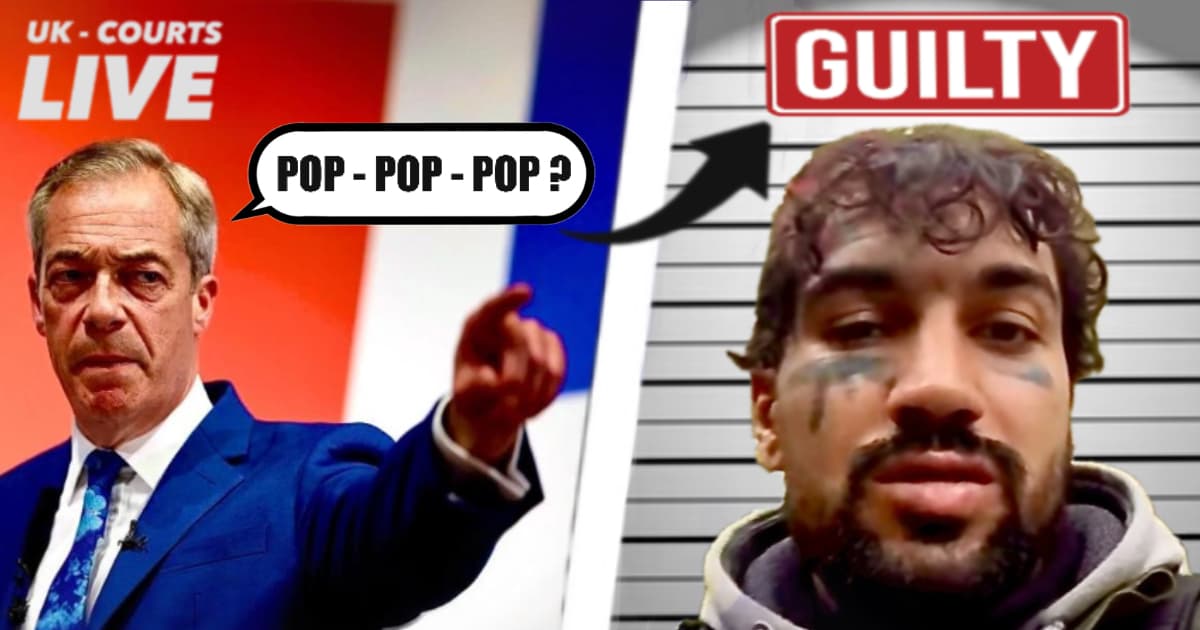
Today Southwark Crown Court delivered a guilty verdict by a majority of 10 jurors to two after the jury deliberated for 11 hours and 55 minutes against Fayaz Khan, the 26-year-old Afghan migrant whose TikTok video threatening to kill Nigel Farage, the Reform UK leader, sent shockwaves through Britain’s legal and political spheres. The jury’s decision, underscored the gravity of online threats in an era where social media amplifies both bravado and menace.
Khan’s conviction under Section 16 of the Offences Against the Person Act 1861 marks a pivotal moment in the intersection of migration, digital platforms, and criminal justice, with the Crown Prosecution Service heralding it as a stark warning to those who wield social media as a weapon.
Additionally, once the guilty verdict was handed down, it was revealed that Khan now faces a further charge of child pornography in Sweden, where he is due to face a court hearing on December 3 in Varmland, south-west Sweden, for allegedly filming a naked girl under 18.
In reference to this In a video posted on the social media, Nigel Farage commented:
The original case stemmed from a provocative exchange ignited on 12 October 2024, when Farage uploaded a YouTube video titled:
The footage spotlighted Khan, who had live-streamed his perilous crossing of the English Channel from France in a small boat, a journey emblematic of the 30,000-plus migrants who arrived in the UK that year.
Farage’s commentary framed Khan as one of the:
Entering Britain with little known about their backgrounds, a narrative that fuelled Reform UK’s anti-migration rhetoric. Khan, sporting a prominent AK-47 tattoo on his face and arm, responded two days later with a TikTok video that would land him in the dock.
No comments yet. Be the first to share your thoughts!
Your email address will not be published. Comments are moderated before appearing.
Addressing “Englishman Nigel,” he demanded Farage delete the video, declared he was “coming to England,” and punctuated his rant with the chilling phrase:
“Pop, Pop, Pop,”
accompanied by gun-finger gestures and a headbutt to the camera.
Pointing to his facial tattoo, Khan signalled he “wasn’t joking,” prosecutor Peter Ratliff told the court.
The prosecution’s case hinged on the video’s “sinister and menacing” nature, arguing it was no fleeting outburst but a calculated threat to instil fear. Ratliff described Khan as a:
citing his tattoos and a subsequent TikTok post captioned “I mean what I say” over a GB News report about the threat.
Additional videos shown to the jury revealed Khan’s recurring use of “pop, pop” noises and gun gestures, reinforcing the prosecution’s portrayal of a man fixated on violent imagery. Farage, who attended the trial, testified that the video was:
admitting he was
Especially given Khan’s apparent affinity for guns.
Khan, who arrived in the UK on 31 October 2024 and was arrested upon landing, denied the charge. Opting not to give evidence, he relied on his defence counsel, Charles Royle, to argue that the video was not a genuine threat but rather an:
Performance. Royle urged jurors to set aside prejudices about Khan’s migration status, face tattoos, or Farage’s polarising politics, including his Brexit legacy and Reform UK leadership.
Addressing Khan’s silence in the witness box, Royle cautioned the jury not to hold it against him, framing the case as a test of intent rather than a referendum on immigration or social media antics.
Khan told police in November 2024 that the video reflected his “character” and typical content style, insisting he never intended to kill or threaten Farage.
The jury rejected the defence’s narrative, finding that Khan’s words and actions were intended to make Farage fear unlawful violence.
The conviction carries a maximum penalty of 10 years’ imprisonment, though sentencing, set for a later date, will likely consider Khan’s lack of prior UK convictions and the context of social media threats, which often result in suspended terms or community orders.
The court heard that Khan, currently detained, has applied for asylum, a claim now complicated by his conviction. Home Office guidance suggests that criminal convictions, particularly those involving threats, can undermine asylum credibility, raising the prospect of deportation to Afghanistan or a safe third country if his claim fails.
The trial unfolded against a backdrop of heightened tensions over small boat crossings and online rhetoric. Farage’s YouTube video, viewed thousands of times, tapped into a broader debate, with 2024 seeing a surge in Channel crossings and public discourse dominated by calls to “stop the boats.” Social media platforms like TikTok have become flashpoints, with migrants like Khan documenting their journeys in real-time, often garnering significant attention.
The Crown Prosecution Service emphasised that the verdict sends a “clear message” about prosecuting online threats, particularly against public figures. This case echoes broader trends, with parliamentary reports noting a 25% rise in threats against MPs since the 2024 election, reflecting the volatile climate surrounding political discourse.
Khan’s journey to the courtroom began in Calais, where he boarded a small boat, live-streaming his voyage to an audience of thousands. His TikTok presence, marked by brash gestures and firearm imagery, contrasted sharply with the defence’s portrayal of a misguided attempt at humour.
The prosecution’s focus on his AK-47 tattoos—etched on both face and arm—underscored a cultural disconnect, with such symbols carrying different weight in Afghan contexts compared to UK courtrooms.
Royle’s defence leaned on precedents like Chambers v DPP (2012), where hyperbolic online statements were deemed non-threatening, but the jury found Khan’s direct targeting of Farage, coupled with violent mimicry, crossed a legal line.
As the metaphorical gavel fell, the verdict reverberated beyond Southwark’s walls, igniting debates on X about migration, free speech, and justice. Some users demanded Khan’s immediate deportation, citing his conviction as evidence of failed border policies, while others dismissed his video as the posturing of a wannabe influencer. But in reality
The case, now awaiting sentencing, stands as a stark reminder of the power and peril of social media in shaping narratives—and consequences—in modern Britain.
11 November 2025 at 17:053 min read
Read More