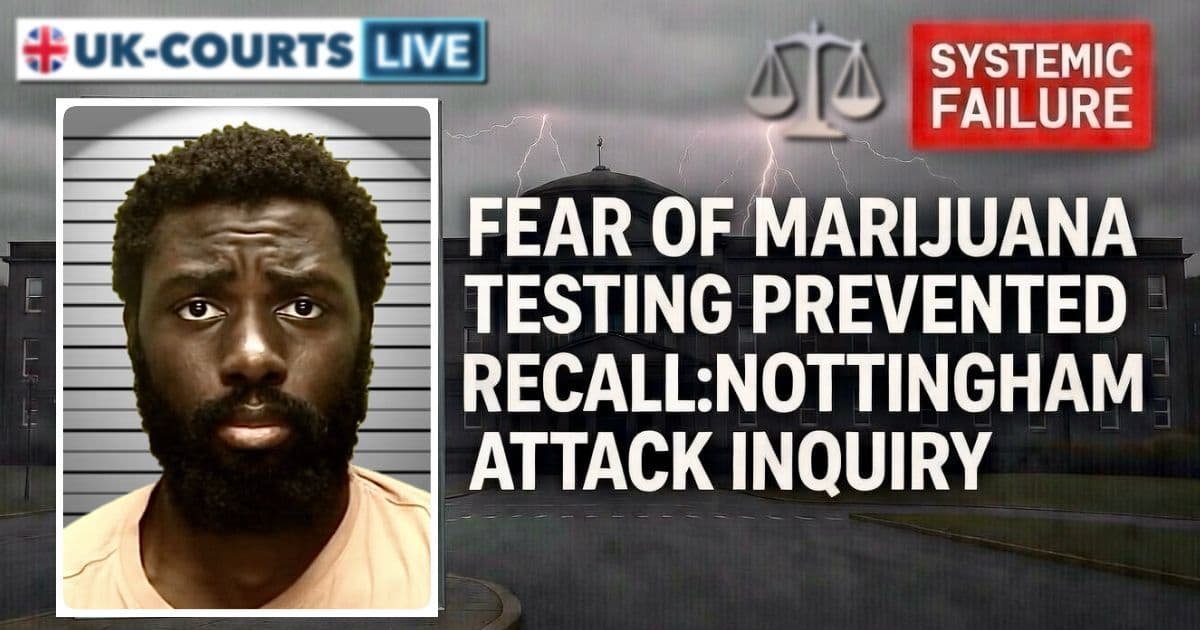
🔴 FEAR OF MARIJUANA TESTING PREVENTED RECALL: NOTTINGHAM ATTACK INQUIRY
Officials warned of psychosis, violence and cannabis risks — yet gaps in monitoring, detention decisions and enforcement left Calocane free before the Nottingham attacks.
Officials warned of psychosis, violence and cannabis risks — yet gaps in monitoring, detention decisions and enforcement left Calocane free before the Nottingham attacks.
A judge-led public inquiry has begun examining the circumstances that allowed the Nottingham attacks of 13 June 2023 to occur, with evidence expected from more than 100 witnesses across health services, police and other public bodies.
The proceedings will scrutinise a sequence of decisions taken in the years before the killings carried out by Valdo Calocane, who later admitted manslaughter by diminished responsibility and attempted murder and was made subject to an indefinite hospital order.
Before turning to the significant developments of the enquiry so far, it is necessary to highlight a critical angle that UK Courts Live believe warrants detailed examination.
Sources have revealed that Valdo Calocane was explicitly warned to abstain from cannabis after being diagnosed with schizophrenia, due to the identified link between the drug and his violent psychotic relapses.
Following his final hospital discharge in February 2022, however, there was no mandatory drug-testing regime in place to monitor whether he was using cannabis, despite the known risk it posed.
Monitoring of his substance use was later described as superficial, “and and he was never subjected to compulsory testing even as concerns about relapse persisted.
Further, he was managed under a voluntary care plan rather than a legally enforceable Community Treatment Order, leaving clinicians without any statutory mechanism to enforce abstinence.
This created a clear blind spot: compliance with a key safety measure — avoiding cannabis — was never objectively verified. A subsequent independent investigation has recommended that, for high-risk patients, refusing a drug test should trigger immediate hospital recall. Yet there is a critical blind spot, as there is no statutory requirement for mandatory testing, meaning the central gap identified in this case remains unresolved. Amid concerns that stricter enforcement of abstinence could potentially have altered the course of events, UK Courts Live will monitor closely what the enquiry concludes regarding the absence of compulsory cannabis monitoring.
So far, the inquiry has heard that, before his escalating outbursts led to later detention, mental health professionals decided not to detain Valdo Calocane in 2020 after considering research on the over-representation of young black men in detention. This decision is now under examination as part of a review into the “events, acts and omissions” preceding the attacks. Counsel to the inquiry Rachel Langdale KC said clinicians had initially been “leaning towards” sectioning him following a violent incident at student accommodation in May 2020, when he repeatedly kicked and punched a neighbour’s door before being restrained.
Related Articles

Comments (0)
No comments yet. Be the first to share your thoughts!
Leave a Comment
Your email address will not be published. Comments are moderated before appearing.