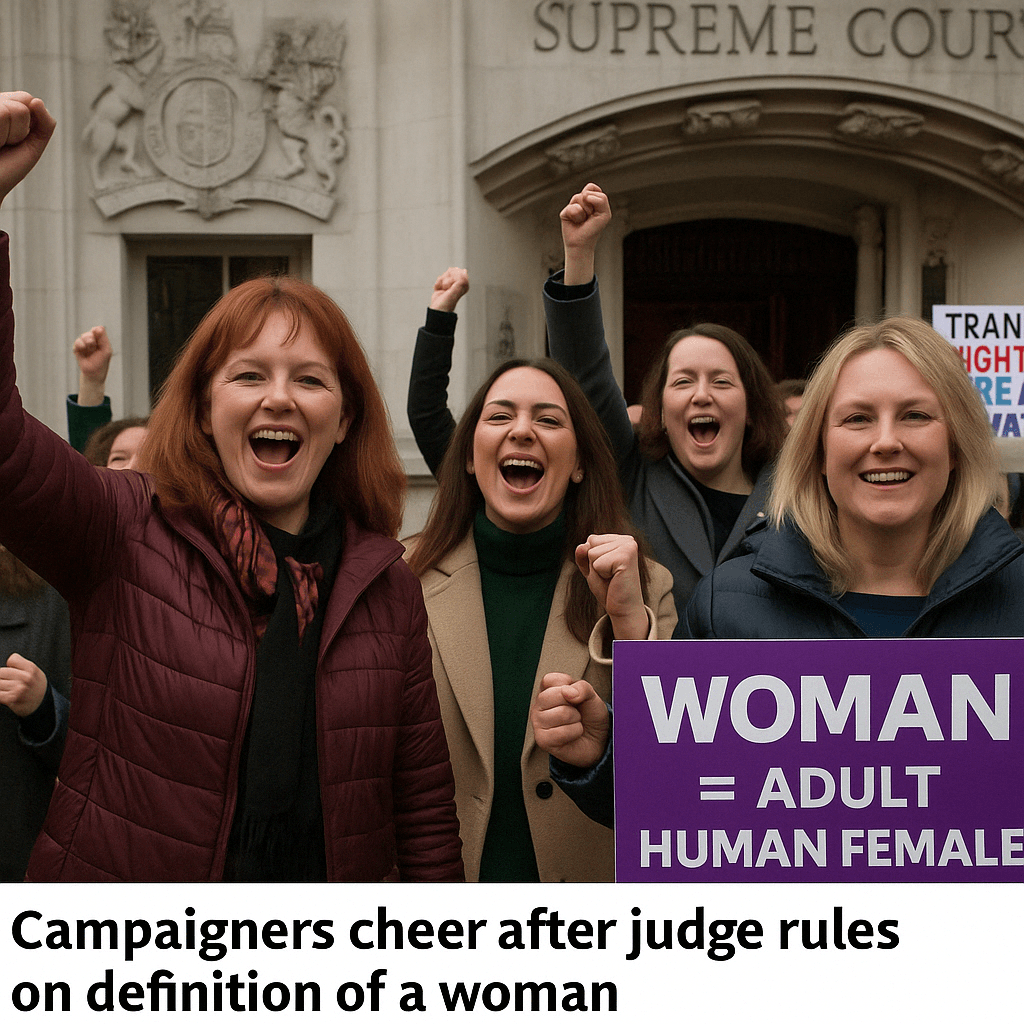
The UK Supreme Court has dropped a judicial bombshell ruling unanimously that under the Equality Act 2010, the terms “woman” and “sex” refer to biological sex only, not gender identity or legal reassignment.
The 88-page ruling concludes that trans women even those with a Gender Recognition Certificate (GRC)cannot be legally classified as women under the Equality Act. The case, brought by For Women Scotland, has stunned political and activist circles, with celebrations erupting on one side and despair on the other.
RESOUNDING AND UNANIMOUS. The Court Makes Definition Crystal Clear
Legal scholar Dr Michael Foran, whose legal writing was cited in court, told BBC Radio 4's PM programme:
He added:
“Today, Trans Rights Died” — India Willoughby.
TV presenter and trans campaigner India Willoughby issued a searing response in her Metro column:
Adding:
EHRC WELCOMES RULING — Says It Resolves “Significant” Legal Confusion
The Equality and Human Rights Commission (EHRC), the UK’s top equalities watchdog, also welcomed the judgment. Chair Baroness Kishwer Falkner released a statement:
No comments yet. Be the first to share your thoughts!
Leave a Comment
Your email address will not be published. Comments are moderated before appearing.
Default
Share this article
Shock Stats, Real-World Impacts
Just 8,464 people across the UK hold a GRC, yet this tiny group was at the heart of a ruling that will shape law, policy, and public space access for over 34 million women and girls.
The judgment will directly impact:
“It’s the Right Way Forward” — Olympian Weighs In
Susan Egelstaff, former Olympian and columnist, told BBC Radio Scotland:
She added:
“Where Do We Go Now?” Trans Advocates Fear Exclusion
Vic Valentine, manager at Scottish Trans, said the ruling could leave trans people excluded from both men’s and women’s spaces:
Politicians React
Kemi Badenoch, Secretary of State for Women and Equalities, said on social media:
MP Rosie Duffield, long-time critic of gender self-ID, called the ruling a “relief”:
What Does It Actually Mean?
Despite the firestorm, the Supreme Court was clear: trans people still have protections under the Equality Act through the separate protected characteristic of gender reassignment.
Lord Hodge stressed that trans people are a “vulnerable and often harassed minority,” and said they remain protected from harassment, direct discrimination, and unfair treatment. However, having a GRC does not grant access to sex-based rights or spaces designated for biological women unless otherwise stated in law.
What Happens Next?
The EHRC is already rewriting its official guidance to reflect the ruling. Public bodies, schools, councils, and companies across the UK will need to review their policies and determine who can and cannot access sex-specific provisions.
Legal experts say the ruling could prompt further litigation especially in education, healthcare, and sport if institutions do not adapt to the court's interpretation.
FINAL WORD
This isn’t just a legal victory, it’s a cultural turning point.
The UK’s top judges have spoken: woman means woman, and that means biological female. Trans rights continue, but they do not override the sex-based protections Parliament enacted to defend women and girls.
Whatever your stance, the message is clear: the law has now drawn a bold red line.
https://supremecourt.uk/uploads/uksc_2024_0042_judgment_aea6c48cee.pdf