
🔴 Wandelt in the Dock: 3 Days of Extraordinary Claims
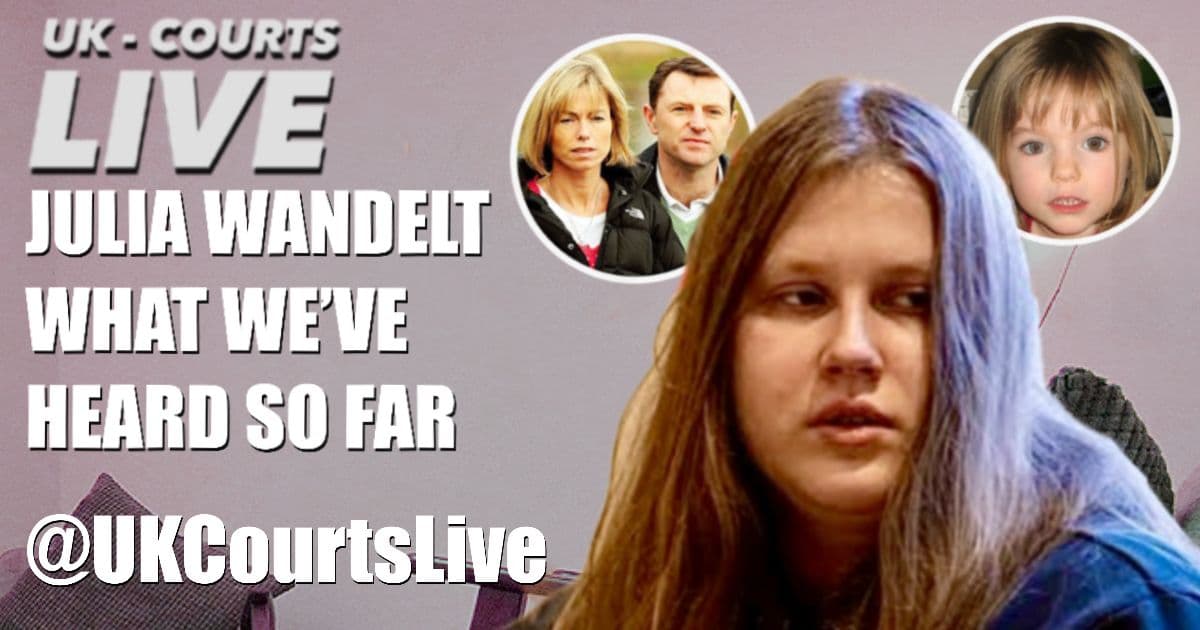
Over three days, Julia Wandelt has stood by a disproven belief she’s Madeleine McCann, forming the extraordinary basis of her defence against stalking charges.
Defendant Julia Wandelt has now completed giving evidence at Liverpool Crown Court, with the jury hearing her account of her persistent efforts to contact the McCann family, and their refusal to engage. Wandelt’s defence to the stalking charges she faces, alongside co-defendant Karen Spragg, is that she acted reasonably, guided by a genuine belief that she could be the missing child of the McCann family.
Wandelt’s three days on the stand have been extraordinary. She outlined claims so unusual that all in attendance were taken on a journey through a world where facts and fictions intertwined, as she sought to justify her behaviour.
On her central claim — that she might be Madeleine McCann — the evidence is unequivocal: DNA analysis, with a one-in-a-billion margin of error, conclusively disproves any match. During cross-examination, Wandelt accepted that she knew her claims were unsupported by scientific evidence. A widely publicised DNA test by California based biochemist Dr. Monte Miller, conclusively proved, if correct, that she is not Madeleine - something Wandelt confirmed under cross examination that she had understood at the time.
Nevertheless, Wandelt maintains that her attempts to contact the McCanns were reasonable. “It would make no sense for them to object,” she told the court, “if there was a possibility I was their daughter.” This framing underpinned her defence, though the law does not provide any professional or moral obligation to contact private individuals in such circumstances.
Her testimony also highlighted the emotional weight of her personal history. Wandelt grew up in Lubin, Poland, and told the court that she experienced abuse from her step-grandfather at the age of nine. Unlike the memories she now claims of a prior life with the McCanns, this abuse was reported at the time, resulting in a 2½-year prison sentence for the perpetrator.
From 2020 onwards, Wandelt described a period of mental health difficulties, including self-harm and suicidal ideation, during which she undertook therapy. She says that “recovered” memories emerged in 2022, prompting her to explore online whether she might be one of several missing children. Her eventual focus on Madeleine McCann came after concluding, based on perceived similarities, that she was the strongest match.
Wandelt denies seeking fame or attention, stating that others may have profited from her story. She told the court she was driven by a personal need for answers, reconstructing a narrative in which she had a British upbringing and was allegedly separated from her biological parents under sinister circumstances. She pointed to clues such as her proficiency in English and alleged knowledge of the McCanns’ home features to justify her belief.
Related Articles
Comments (0)
No comments yet. Be the first to share your thoughts!
Leave a Comment
Your email address will not be published. Comments are moderated before appearing.