West Midlands Police’s Maccabi Ban Scandal: Smoking Gun of Inaction inExposed
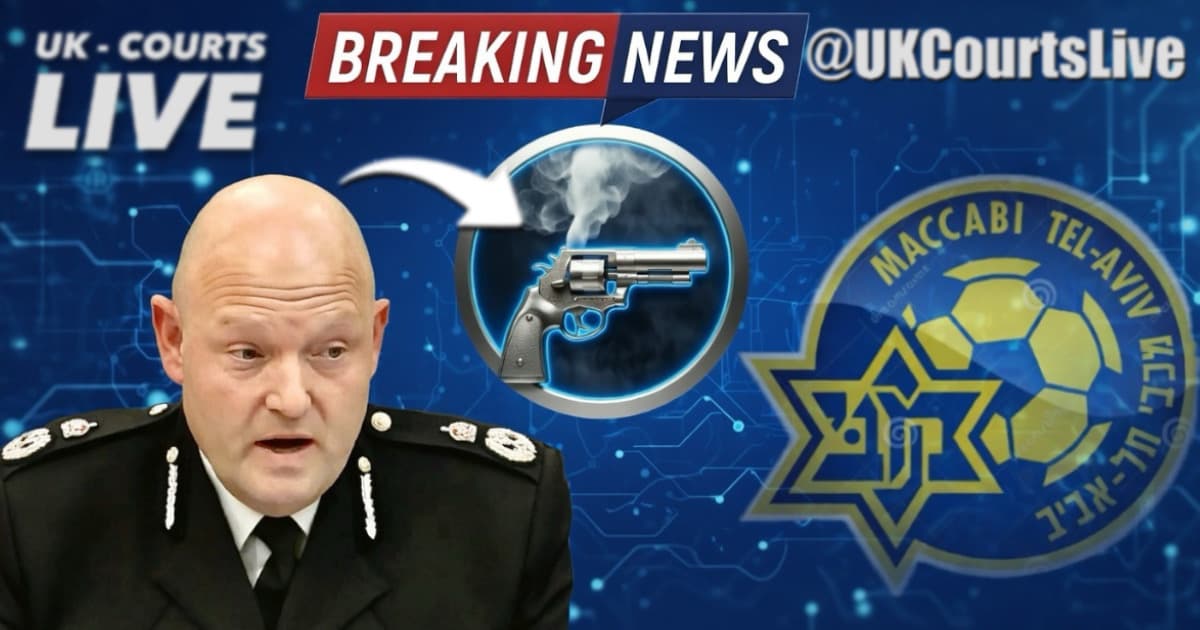
It’s been uncovered that West Midlands Police (WMP)’s failed to arrest Kashmiri Islamic extremists in Birmingham for inciting religious hatred and violence against Maccabi Tel Aviv fans back in September 2025.
This deliberate inaction served to preserve the false narrative blaming Israeli supporters, inverting threats and fuelling accusations of two-tier policing.
The true “smoking gun” in this saga that most are still not seeing lies in WMP’s September inaction: Messages that have come to light show clear breaches of the Public Order Act 1986, where words or materials “likely to stir up racial hatred” (Section 18) or religious hatred (via the Racial and Religious Hatred Act 2006) were rampant, including calls for organised violence against Israeli fans perceived as symbols of broader geopolitical grievances.
Under CPS hate crime policy, such evidence—demonstrating intent or foreseeable harm—should have triggered arrests if “necessary” under PACE Code G, especially given the public interest in preventing escalation.
Yet, no action was taken, allowing the narrative to pivot toward Maccabi as the instigators rather than the victims of premeditated local threats.
Had these arrests occurred, the story transforms dramatically: The public domain would spotlight the substantial risk from Birmingham’s own Kashmiri communities, undermining WMP’s pretext for the ban and forcing a balanced risk assessment that might have permitted the match with enhanced security.
This early enforcement could have deterred further incitement, mirroring successful proactive arrests in the 2024 UK disorders that contained riots without widespread chaos.
However, it would likely ignite short-term unrest in local Islamic communities, where pro-Palestine and Kashmir solidarity sentiments run deep—potentially sparking protests, accusations of “Islamophobia,” and “deep unrest” as arrests paint a “negative view” of these groups, exacerbating tensions in Labour-stronghold Birmingham.
Legally, this inaction skirts misconduct thresholds under the Police (Conduct) Regulations 2020, inviting judicial review or IOPC probes for irrationality or bias, while optically eroding trust in policing as “two-tier.”
No comments yet. Be the first to share your thoughts!
Leave a Comment
Your email address will not be published. Comments are moderated before appearing.
Default
Share this article
Unpacking WMP’s Cascade of Failures
Beyond the non-arrests, WMP’s mishandling reveals a pattern of procedural and ethical lapses that compounded the scandal. The misrepresentation of intelligence, for instance, violated core principles of transparency in decision-making.
By emphasising the unminuted Dutch Zoom call—alleging Maccabi fans’ role in “running battles”—while Dutch authorities publicly refuted it in their November 11, 2024, report (highlighting threats targeted at Maccabi), WMP engaged in what critics call “selective evidence presentation.”
This not only breached CPS guidelines on full disclosure but also exposed the force to misconduct allegations, as the IOPC now assesses whether this amounted to “retrofitting” to justify the ban post hoc.
The suppression of Lord Mann’s report further underscores a “filtering” bias: As a government advisor on antisemitism, Mann’s findings detailed attacks on Maccabi as racially motivated, directly contradicting WMP’s narrative.
Roberts’ admission in the December 1, 2025, Home Affairs Committee hearing that he deemed it “superseded” by the Dutch call represents a procedural failure, potentially infringing on duties under the Human Rights Act 1998 (Article 14, non-discrimination) by sanitizing intel that could have protected vulnerable groups.
Had this report been shared with the SAG, a more nuanced view might have prevailed, avoiding the “unique” ban that critics like the Board of Deputies label a “victory for extremists.”
Finally, abandoning alternatives like the Walsall fan zone— a proven strategy from past high-risk fixtures—highlights disproportionality under the Equality Act 2010, where decisions must not indirectly discriminate.
WMP’s choice to ban rather than mitigate, despite initial plans assuming fans’ attendance, suggests resource or political aversion, fueling “two-tier policing” claims.
These failings, now under HMIC review ordered by Home Secretary Shabana Mahmood, could lead to systemic reforms but at the cost of eroded public faith in impartial enforcement.
The Political Reckoning: Reform UK Demands Guildford’s Head
As the internal evidence of WMP’s procedural decay continues to leak, the fallout has moved from the operational to the existential.
In a move that shifts the crisis from the briefing room to the doorstep of the Home Office, Reform UK Birmingham has issued an explosive open letter to PCC Simon Foster, explicitly calling for the immediate dismissal of Chief Constable Craig Guildford.
This isn’t merely political grandstanding; the letter—seen by Video Production News—it mirrors the very "smoking gun" evidence we have uncovered.
Reform UK’s charge of a "profound failure of governance" finds heavy support in the WMP’s own documentation.
When the party alleges that intelligence was "selectively sought to legitimise a decision already taken," they are pointing directly at the same unminuted Dutch Zoom calls and suppressed reports that our own investigation has highlighted.
The letter pulls no punches, branding the Maccabi ban the "culmination of an overtly political campaign" involving local Labour figures and MPs—a move they argue abandoned the principle of equal treatment under the law to accommodate "fear, pressure and discrimination."
Reform’s position gains massive credibility when viewed alongside the force's failure to arrest extremists in September. By holding back on enforcement against clear incitement to hatred, WMP inadvertently (or otherwise) curated the "high risk" environment they then used to justify the ban.
Reform is right to warn of a "dangerous precedent" where "political intimidation and mob pressure" dictate British policing; it is a sentiment that resonates deeply with a Jewish community left feeling uniquely targeted and a wider public weary of perceived "two-tier" enforcement.
Removing the Chief Constable, as Reform suggests, may indeed be the "only practical first step" to restoring a reputation that isn't just tainted—it's under forensic siege.
The Road Ahead – Accountability or Cover-Up?
Synthesising the evidence, WMP’s September failure to arrest the extremist leaders for blatant Public Order Act breaches—despite ironclad messages inciting hatred and violence—set the stage for a cascade of blunders: twisted intel prioritizing disputed Dutch claims, suppressed Mann reports sanitizing antisemitism, and ditched fan zones that could have saved the match.
This pattern not only inverted threats to shield local risks but exposed a potential bias in enforcement, breaching CPS hate crime mandates and fueling “two-tier policing” firestorms amid Birmingham’s tense demographics.
The "Smoking Gun" of the September non-arrests provides the undeniable evidentiary foundation for the political ultimatum now landing on the PCC's desk.
The Reform UK open letter, demanding Chief Constable Craig Guildford’s immediate dismissal, isn’t merely a partisan strike; it is the natural consequence of a force that appears to have prioritised "political accommodation" over the impartial application of the law.
By choosing to target the victims rather than confront the perpetrators, WMP has validated Reform's charge of a "profound failure of governance" and a "dangerous precedent" that allows mob pressure to dictate the boundaries of public order.
Going forward, outcomes hinge on scrutiny: The IOPC could escalate to full misconduct probes, triggering judicial reviews or even negligence suits from Jewish groups; Guildford’s resignation demands, now backed by Reform’s formal call for his sacking, may culminate in an outcome that echoes Rotherham-era reckonings; broader reforms might overhaul hate crime handling, closing NFIP gaps and mandating transparency.
Yet, if the PCC and the Home Office continue to stonewall, they risk permanently eroding public trust and handing extremists a playbook for unchecked intimidation.
In the court of public opinion, WMP’s verdict is pending—but justice delayed on the streets of Birmingham, as evidenced by the inaction in September and the political fallout of today, could prove justice denied for all.
A Vital Civic Lesson: Ignorance of the Law Is Not a Defence