Rupert Lowe: The Tory Twist Too Taboo to Talk About?
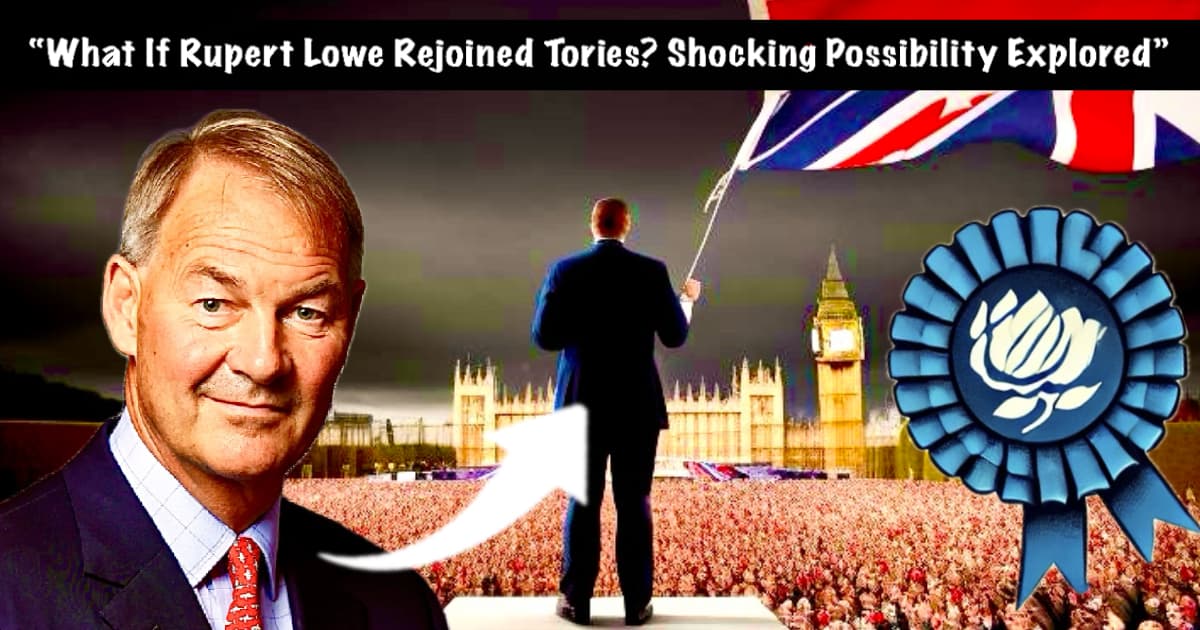
Could Rupert Lowe make a shock return to the Conservatives? It sounds far-fetched—but is it really? We explore the bold political twist no one’s daring to discuss.
By Ben Freeman
I am finding it increasingly curious that, following Rupert Lowe’s abrupt and notably uncomfortable departure from Reform UK, many political commentators have been quick to speculate on what comes next—yet remarkably silent on one potential outcome that, while undoubtedly improbable, cannot in good faith be dismissed as unthinkable.
In this purely speculative Op-Ed, the intention is not to advocate for any one course of action, nor to suggest inevitability. Rather, it is to examine an outcome which, though rarely acknowledged in public debate, may soon warrant serious strategic consideration. That possibility is this: Rupert Lowe rejoining the Conservative Party.
At present, this scenario may seem implausible to many—if not outright provocative. But when subjected to cool deductive reasoning, stripped of sentiment and viewed through the lens of political mechanics, it emerges as not only a feasible outcome but perhaps, under certain conditions, the most practical option available to Lowe if he intends to retain political relevance.
To begin with, the structural landscape of British politics offers few realistic avenues for a politician who has parted ways with a rising party and wishes to maintain national influence. The establishment of a new political party may be a theoretical possibility, but in real terms it is weighed down by the sheer logistical, legal, and electoral challenges involved. The British electoral system is notably unforgiving toward smaller or newer entrants. Without a network of sitting MPs, widespread donor infrastructure, and long-term media visibility, a new party rarely becomes more than a protest platform.
That route, while sometimes appealing rhetorically, is in practice a long shot. Remaining politically active without a platform, meanwhile, amounts to symbolic commentary at best. One can maintain a presence on social media, or continue giving interviews, but in terms of affecting policy, shaping legislation, or commanding public narrative, the impact is inherently limited.
Which brings us back to the only remaining mainstream political structure capable of delivering outcomes on issues long prioritised by Lowe—matters such as constitutional integrity, judicial reform, and national sovereignty. For better or worse, the Conservative Party still houses the apparatus of political influence, the institutional infrastructure, and the access to policymaking necessary to enact such reforms.
Related Articles

Comments (0)
No comments yet. Be the first to share your thoughts!
Leave a Comment
Your email address will not be published. Comments are moderated before appearing.