
🔴 Southport Disorder, AG Consent and the Hidden Legal Scandal
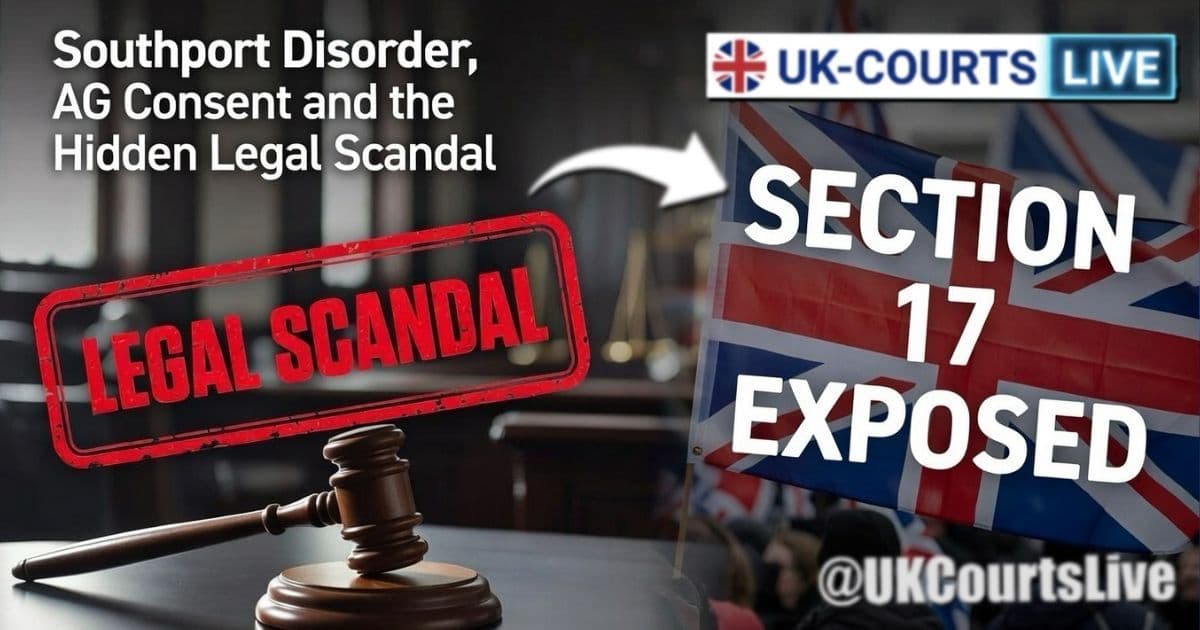
Southport disorder prosecutions spark outrage, but the real story isn’t AG consent—it’s a controversial law that turned political outrage into racially aggravated offence.
Recent commentary surrounding the prosecution of Lucy Connolly has focused intensely on the speed with which her case moved through the criminal justice system and, in particular, on the fact that consent for the prosecution was obtained from the Attorney General’s Office within hours. For those who view the jailing of the Northampton childminder for “intending to stir up racial hatred” as unfair, these new details have been presented as evidence of political involvement or exceptional treatment, and as proof that the ordinary rules were suspended to secure a particular outcome.
This, however, misinterprets standard legal procedure and the ignores the precedent for expediting cases during periods of national disorder for legitimate law and order purposes.
And crucially, it overlooks the core objection that labelling her, and many others who opposed asylum and immigration policy, as “racist” , landing them with harsher sentences, was wrong.
Controversial legislation that includes national origin in the definition of race resulted in extra jail time for those found guilty during the Southport disorder. This should be the focus for anyone questioning the fairness of her conviction as a “racist”.
Claims of political interference have focused on Lord Hermer, the Attorney General, and Prime Minister Keir Starmer, but they rest on a misunderstanding of the law governing these offences and its operation during periods of public disorder.
Connolly was charged with an offence contrary to section 19 of the Public Order Act 1986, which sits within Part III of the statute dealing with the stirring up of racial hatred. These prosecutions require the consent of the Attorney General as a mandatory procedural gate. The Attorney General’s role in this context is analogous to a judicial authorisation in other situations.
When a judge grants a warrant to search premises suspected of containing stolen vehicles, their ‘approval’ is rarely frames as evidence of lack of due process driven by a wish to target the suspects. It reflects a professional judgment of the weight of the evidence, and a determination that the statutory threshold has been met and that the proposed search is lawful. Criticism of such a decision must be framed in legal terms — that the test was wrongly applied, precedent misread, or the authorisation disproportionate — not on the basis that the outcome is unpopular or the decision-maker controversial.
Attorney General consent performs an equivalent function. It acts as a constitutional safeguard for speech-related offences, requiring a Law Officer to confirm that the statutory conditions for prosecution are satisfied before proceedings are instituted. Operational decisions, including arrests, charging, and case strategy, remain with the police and the Crown Prosecution Service. Consent does not direct these decisions, nor does it allow the Attorney General to select defendants at will. It simply opens the gate for the prosecution to proceed lawfully.
Related Articles

Comments (0)
No comments yet. Be the first to share your thoughts!
Leave a Comment
Your email address will not be published. Comments are moderated before appearing.